Digital Nomad Visa
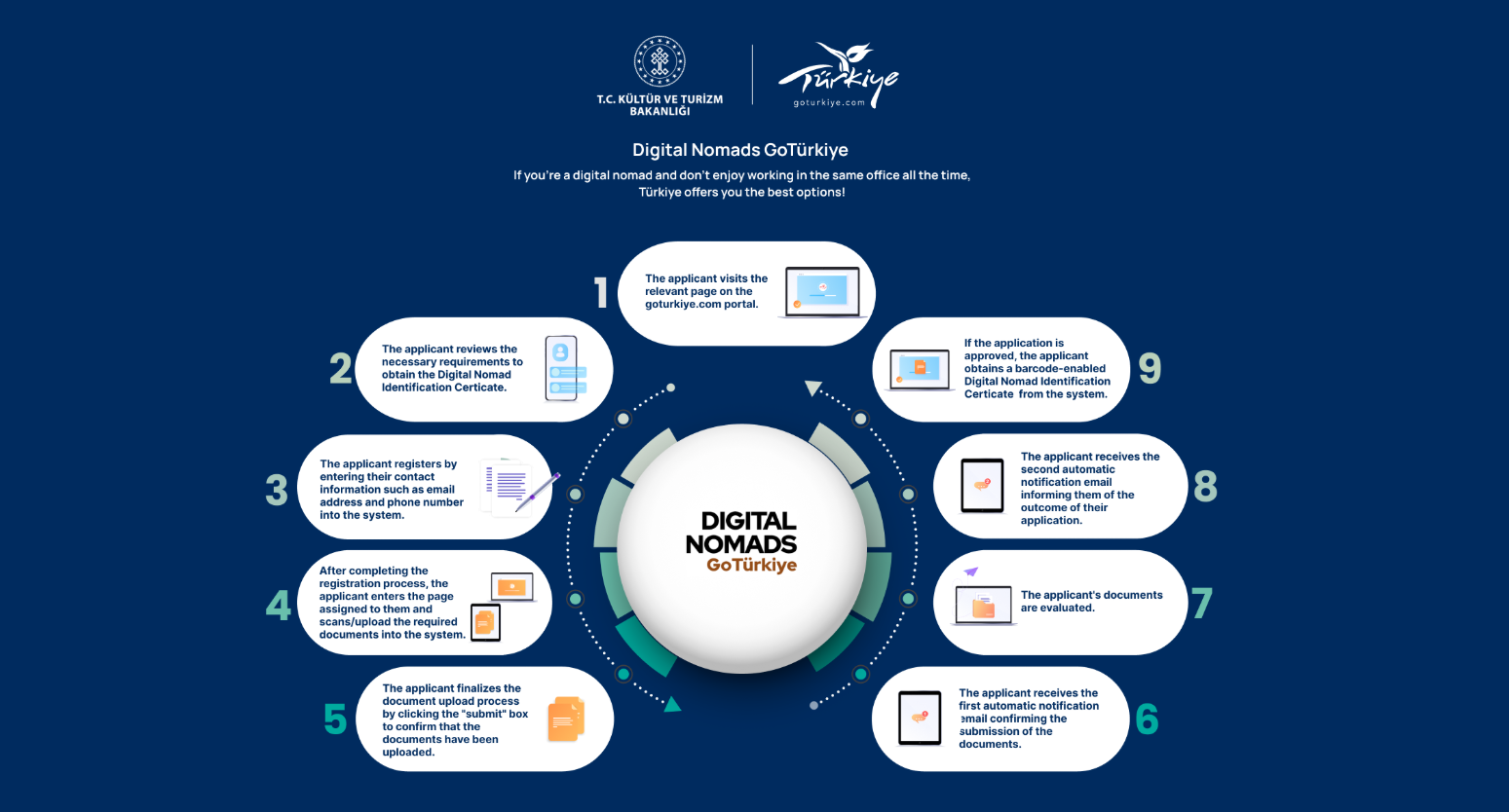
With the widespread adoption of remote working systems, many people are no longer limited to living in a single country. This new working structure has encouraged countries to develop alternative residence models. In Turkey, one of the most prominent options in recent years is the application model commonly known as the digital nomad visa.
The digital nomad visa is a residence-based application model that allows foreign nationals who work for a company located outside Turkey and earn their income from abroad to legally reside in Turkey. As tourist residence permits have become increasingly difficult to obtain, this model has become an important alternative for remote workers who wish to live in Turkey.
For What Purpose Is the Digital Nomad Visa Granted?
The main purpose of this application model is to allow individuals to legally reside in Turkey without working in Turkey or generating income from Turkish sources, while continuing to earn income from abroad. For this reason, digital nomad applications should not be confused with work permits. The applicant does not work for a Turkish employer and continues their professional activities remotely for a foreign company.
In practice, professionals working remotely in fields such as information technology, software development, design, digital marketing, finance and online customer support frequently apply under this model. One of the most critical elements of the application is the ability to clearly document that the applicant is genuinely working remotely.
An official letter obtained from the applicant’s foreign employer plays an important role in the application file. This letter should clearly state that the individual is actively employed by the company, performs their duties remotely, that residing in Turkey does not affect the employment relationship, and that the applicant will continue working remotely while living in Turkey. A clear, consistent and official format significantly strengthens the application file.
Who Can Apply for the Digital Nomad Visa?
The primary requirement for a digital nomad application is active employment with a company registered outside Turkey. There is no obligation to work for a Turkish company, generate income in Turkey or show a Turkish employer.
In practice, the highest number of applications comes from citizens of the Russian Federation. However, digital nomad applications are not limited to Russian nationals. According to current practices, citizens of France, Germany, Italy, Belgium, the Netherlands, Luxembourg, Ireland, Denmark, Greece, Croatia, Spain, Portugal, Austria, Finland, Sweden, the Czech Republic, Hungary, Poland, Slovenia, Slovakia, Estonia, Latvia, Lithuania, Malta, Bulgaria, Romania, Norway, Iceland, Liechtenstein, the United Kingdom, Switzerland, the United States, Canada, Ukraine and Belarus may also apply under this model.
Applications are evaluated individually based on the applicant’s profession, working structure, submitted documents and overall file consistency. Therefore, document quality and clarity are among the most decisive factors in the evaluation process.
How Long Is the Digital Nomad Residence Permit Granted?
In practice, residence permits issued under the digital nomad model may be granted for periods ranging from six months to one year. During 2025, many applications were approved for six months, while more recent applications have in some cases been granted for one year. However, the final duration depends entirely on the evaluation of the migration authorities.
Tax Advantage of the Digital Nomad Model in Turkey
In many European countries, individuals residing long-term under digital nomad status may become subject to local tax obligations. In countries such as Spain and Portugal, long-term digital nomad residence may result in additional tax responsibilities.
In Turkey, the system operates differently. There is no separate residence permit category officially titled “digital nomad visa.” The application is technically submitted as a tourist residence permit, as there is no digital nomad option in the appointment system. However, the application file itself is supported by digital nomad documentation based on remote employment.
Due to this structure, applicants do not face an additional tax obligation specifically related to digital nomad status in Turkey. This approach makes Turkey a more attractive destination compared to many European alternatives.
Can a First-Time Applicant Obtain Residence Through the Digital Nomad Model?
One of the most common questions concerns whether individuals who have never held a Turkish residence permit can apply under this model. According to current practices, digital nomad-based applications may also be evaluated for first-time residence applicants.
The key factor is the completeness and consistency of the application file. When remote working documentation is properly prepared and clearly presented, digital nomad-based applications are considered among the stronger residence options available.
Conclusion
For foreign nationals who work remotely and wish to live in Turkey, the digital nomad model has become one of the most practical and reliable residence options today. As tourist residence permits have become increasingly difficult to obtain, this system provides a lawful alternative for individuals earning income from abroad.
Proper document preparation, accurate declarations and a file structure aligned with remote working principles are the most critical factors for a successful application process.
📞 Consulting Support
For detailed information about the digital nomad visa and residence permit application processes in Turkey, you can contact us.