Renewing a Residence Permit in Turkey: Deadlines, Documents, and Overstay Risks
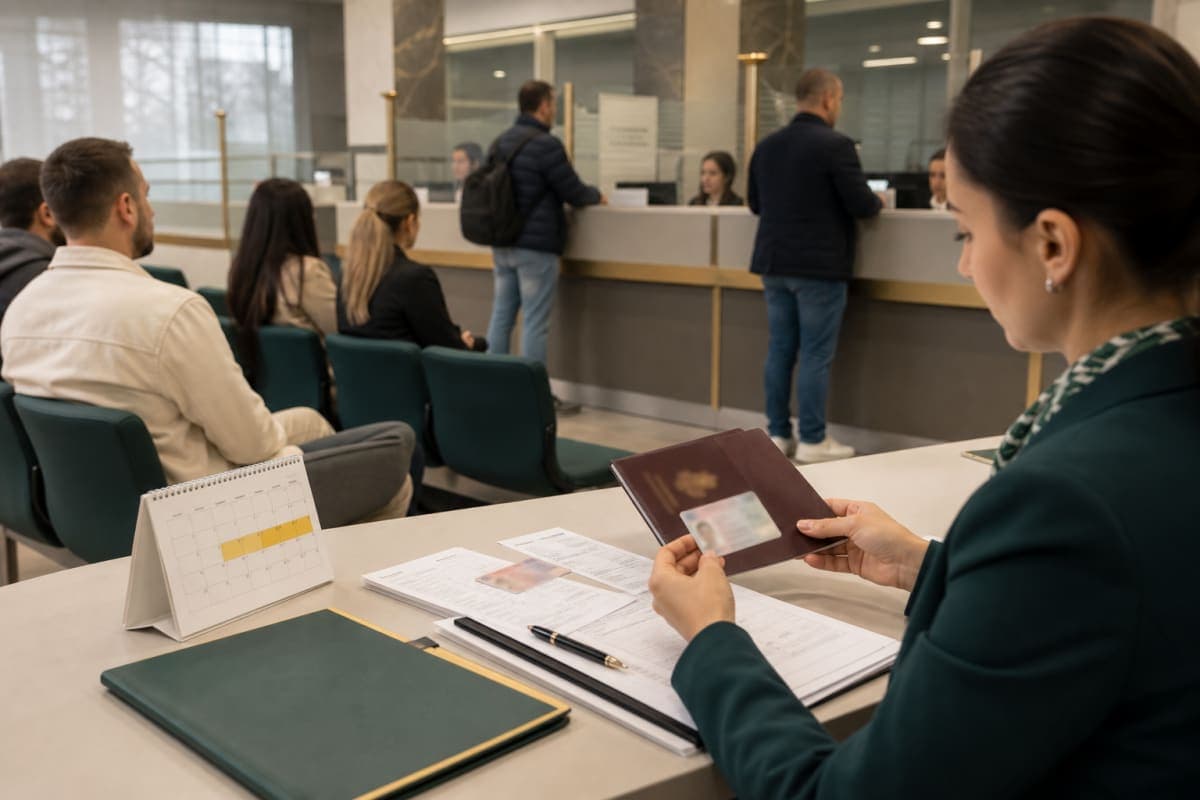
To renew a residence permit in Turkey, you must submit an online e-İkamet application within the last 60 days of your current ikamet and always before its expiry date. After submission, the applicant prepares updated documents, pays the government fees, attends an appointment if required, and tracks the decision of Göç İdaresi. The main risk is overstaying: it may lead to fines, problems when leaving Turkey, and refusal of a new application.
Renewing an ikamet is not an automatic formality, but a fresh assessment of your grounds for residing in Turkey. Even if you have previously received a card, the migration authority will again check whether your address, health insurance, passport, financial situation, and purpose of stay are still valid. Below is a practical action calendar for foreigners who want to maintain legal status and avoid last-minute panic.
Step 1: Check the ikamet expiry date and renewal calendar
Start with the front side of your residence permit card: it shows the expiry date of the permit. A renewal application can be submitted no earlier than 60 days before that date and no later than the last day of validity of the current residence permit. This rule is important: if you try to apply earlier, the system will not allow you to process the renewal, and if you are late, your status may become overdue.
In practice, it is better not to wait until the last week. Check your passport, insurance, lease agreement, or address confirmation in advance, because some documents may need to be updated, translated, or additionally verified. If you are planning to travel abroad, keep in mind that after submitting a renewal application you need to have proof of the application and comply with the exit rules published by the migration authority. For an initial understanding of how the system works, it is useful to compare the process with the material on applying for a tourist residence permit through e-İkamet, but for renewals the main focus is on continuity of status.
Step 2: Make sure your residence permit grounds are still valid
Before completing the form, determine the basis on which you are renewing the permit: short-term, family, student, or another type of ikamet. Turkey assesses not only the fact of residence itself, but also the purpose of stay, so the previous grounds must be confirmed again. For example, a student will need an up-to-date certificate from the educational institution, while a family member will need documents confirming the family relationship and the sponsor’s status.
If your situation has changed, you should not automatically copy your previous application. Moving to another city, completing your studies, divorce, changing rental housing, or switching to another type of stay may change the document package. For certain categories, it is important to check the specific requirements: for example, documents for a student residence permit in Turkey differ from a family package, while a family residence permit in Turkey for spouses and children requires a separate document check for each family member.
Step 3: Update your address, insurance, and passport details
The address is one of the most common reasons for questions during renewal. If you have moved, check whether your actual address is reflected in the system and matches the documents you submit. The lease agreement, notarized confirmation, address registration, and the data in the application form must not contradict each other. If the address is not up to date, it is better to resolve this before submission rather than explain discrepancies at the appointment.
Health insurance must cover the period of the requested residence permit, except in cases where special rules apply due to age or state insurance. The passport must also be valid for the period you indicate in the application. If the passport is close to expiry, the migration authority may limit the permit period or request clarification. For more details on what to do after receiving the card, see the material on address registration in Turkey after obtaining a residence permit.
Step 4: Submit the e-İkamet application and save the confirmation
Renewal is processed through the official e-İkamet system. In the application form, it is important to correctly indicate the permit type, period, address, contact details, passport information, and insurance details. After completion, the system generates the application registration document and, where applicable, information on government payments. The amounts are not universal: they depend on citizenship, permit type, duration, and other parameters, so you should rely on the calculation in the official system.
Save the PDF application, the application number, and all payment confirmations. Until a decision is issued, these documents help confirm that you submitted the renewal on time. If the system assigns an appointment, print the form and prepare the original documents. If your province provides for submission by post or another procedure, follow the instructions shown in your personal application and on the migration authority’s website.
Step 5: Pay the fees and prepare the package for the appointment
After the online application, check which payments are shown by the system: usually these are the government fee for the permit and the plastic card fee, while additional payments may apply to some applicants under the rules of the migration authority. We do not recommend using average amounts from chats, because payment amounts vary depending on individual data. The reliable source is the official calculation in e-İkamet and receipts from authorized payment channels.
Bring originals and copies of documents to the appointment in a neatly organized folder. Documents in a foreign language, if required for the residence permit grounds, may need translation, notarization, or an apostille depending on the country of issue and the type of document. If you submit marriage certificates, birth certificates, certificates, or court documents, check the legalization requirements in advance; you can use the article on apostille, translation, and legalization of documents for submission as a reference.
Step 6: Track the status and avoid overstaying
After the application is submitted and the documents are handed over, the decision remains with Göç İdaresi. The status can be checked through official channels, and notifications may arrive by SMS or email if the contact details are entered correctly. During this period, it is important to keep your phone active, not ignore requests from the migration authority, and respond quickly if an additional document is required.
If the renewal is submitted on time, the applicant usually retains a legal basis to wait for the decision on the application, but this does not mean freedom to violate the conditions of stay. Leaving Turkey while the application is under review is possible only subject to the current rules and supporting documents; before traveling, you must check the latest instructions. If you missed the submission deadline and your ikamet has expired, do not try to renew it retroactively: the risks of a fine, departure, re-entry, and possible refusal must be assessed separately.
List of documents for renewing a residence permit in Turkey
The exact list depends on the type of ikamet, the province, and your personal situation. Below is a basic guideline that is most often checked during renewal. Before submission, always compare your package with the e-İkamet form and the requirements of the local migration office.
If you have a family, student, or other special basis, profile-specific confirmations are added to the basic documents. Do not submit an incomplete package in the hope of bringing the missing document later if it can be prepared in advance. The fewer discrepancies there are between the application form and the papers, the lower the risk of delay, an additional request, or postponement of the decision.
- Completed and signed residence permit renewal application form.
- Original and copy of the passport, including pages with personal data and entry stamps.
- Copy of the valid ikamet card.
- Biometric photographs that meet the requirements of the migration authority.
- Valid health insurance for the requested period, if required.
- Document confirming the residential address in Turkey: lease agreement, address registration, or another applicable document.
- Receipts for payment of government fees, if payments are assigned by the system.
- Documents supporting the residence permit grounds: university certificate, family documents, proof of income, or other applicable papers.
- Translations, notarizations, apostille, or consular legalization if required for a foreign document.
What to pay attention to in order not to lose legal status
The main mistake is considering the appointment date as the submission date. To meet the deadline, it is critical to complete the online application before the current ikamet expires. If the form is submitted after the card has expired, the migration authority may treat the situation as a violation of the permitted stay period. The consequences depend on the circumstances and may include an administrative fine, restrictions when leaving Turkey, or difficulties with subsequent applications.
The second common problem is a mismatch between the address and the documents. For example, the application form lists one address, the lease agreement shows another, and actual residence is not confirmed. Expired insurance, incomplete payment of fees, mistakes in the passport number, missing translations, or an attempt to renew a residence permit without a real basis also create risk. If you have doubts, it is better to conduct a preliminary check of the package before submitting the application.
Comment from ESG Consulting
ESG Consulting has been working with foreigners in Turkey for more than 6 years and sees that most renewal problems arise not because of complex laws, but because of late preparation. People remember the card a few days before expiry and discover that the insurance does not cover the required period, the lease agreement is prepared incorrectly, or the address has not been updated. As a result, a simple renewal turns into an urgent crisis case.
We recommend starting the check 6–8 weeks before the ikamet expires: this matches the permitted submission window and leaves time to correct documents. A consultation is especially useful if you are changing the type of residence permit, have moved to another province, are applying as a family, have previous refusals, or have been outside Turkey for a long period. Our task is not to promise a guaranteed result, but to prepare a clear, verifiable, and well-organized package that meets the requirements of Göç İdaresi.
Where to Apply for Extension?
Initial, extension and transition applications are taken online through the e-İkamet system. The official portal used for applications is e-İkamet.
In extension applications, previously entered information in the system must be checked and entered without errors. Particularly, mistakes in fields such as identity information, passport details, address and application type can affect the file review. If there are changes in information, the application form should be filled according to the current situation; if there are no changes, old information should be checked before being transferred as is.
Making the application online does not mean the process is completed entirely digitally. After creating the form through e-İkamet, the required documents must be completed and the application must be delivered to the relevant Provincial Directorate of Migration Management.
How Are Documents Submitted?
According to the Presidency of Migration Management's statement, in extension applications, after completing the required documents, they must be sent by mail to the Provincial Directorate of Migration Management of the province of residence within 5 days. This period is important for delivering the file to the institution after completing the e-İkamet application.
Extension applications require a translated notarized copy of the passport. This is a point that differs from initial and transition applications; in initial and transition applications, the original passport must be presented.
During the document submission stage, additional documents may be required according to the type of residence applied for. Therefore, the document guidance generated at the end of the application in the e-İkamet system should be checked separately.
Importance of Address Declaration
Address information in residence permit applications determines which province the applicant resides in Turkey and which Provincial Directorate of Migration Management will evaluate the file. Since the extension application is sent to the Provincial Directorate of Migration Management of the province of residence, address information is decisive for directing the file to the correct administration.
Applicants with address changes must reflect their current status in the e-İkamet form. Using wrong province, wrong address or old information may create the need for additional explanation or correction during application evaluation. In case of city change, the topic of Changing Cities with a Residence Permit should be checked separately.
Health Insurance Requirement
Health coverage is one of the basic elements of residence permit applications. In the general information from the Presidency of Migration Management, documents that can substitute for health insurance are clearly listed:
- Private Health Insurance
- E-signed/signed and stamped provision document obtained from the Social Security Institution
- E-signed/signed and stamped document regarding the application made to the Social Security Institution to become a General Health Insurance holder
- Document showing that health services are benefited from in Turkey within the scope of bilateral social security agreements
The detail here is not only the existence of the document, but the way the document is prepared; signature, stamp, company stamp or e-signature quality is important in terms of the document standard required in the application.
Does the Process Change According to Residence Permit Type?
Six types of residence permits are regulated in Law No. 6458 on Foreigners and International Protection. Therefore, although the general path of extension application is the same, the required documents and evaluation framework may change according to the type of residence permit the applicant holds.
For example, applying for student, family, short-term or another type of residence permit may affect the supporting documents to be sought in the file. This distinction should be made correctly when selecting the application type through the e-İkamet system. For those with student status, Student Residence Permit Extension, and for those under family residence, Family Residence Permit Extension process is particularly important.
Is Application Through Authorized Intermediary Institution Possible?
With the provision added to Article 21 of Law No. 6458, it is regulated that residence permit applications can also be made by authorized intermediary institutions. Authorized intermediary institution refers to an institution or organization authorized by the Migration Administration; their qualifications and scope of duties are determined by regulation.
This regulation does not mean that the application must necessarily be conducted by the applicant alone. However, if the administration deems necessary, it may request the foreigner to be present during the application. Therefore, preparing the file through an intermediary does not mean that the applicant will not be called to the institution at any stage.
Is Residence Permit Required for Those with Work Permits?
Work permit substitutes for residence permit. According to the Presidency of Migration Management's statement, a foreigner with a work permit has the right to stay in Turkey without obtaining a separate residence permit during the work permit period.
This information is important for foreigners who are evaluating both work permit and residence permit processes simultaneously. A person with a valid work permit may not need to apply for residence permit extension separately during the period covered by the work permit. However, the duration, nature of the work permit and the person's plan to stay in Turkey should be evaluated together; because when the work permit expires, the basis for the right to stay in Turkey may also change.
Process After Application
After the extension application is made through e-İkamet and documents are sent by mail to the relevant Provincial Directorate of Migration Management, the file is reviewed by the administration. If incomplete or incorrect information is found in the application, the institution may conduct additional evaluation or request explanation from the applicant.
At this stage, the information in the application form and the submitted documents must be compatible with each other. Finding contradictions between passport information, address, insurance document and application type may delay the completion of the file. One of the most common problem points in extension applications is re-entering previously given information without checking.
In case of application refusal, the path to follow changes according to the content of the refusal decision and the applicant's situation. The reason stated in the refusal decision must be read carefully; because the framework of the next application or legal evaluation is determined according to this reason.
The basic logic in the residence permit extension process is clear: the process is initiated through e-İkamet without missing the application deadline, information is entered in a way that is compatible with previous records and current, required documents are completed and the file is sent to the Provincial Directorate of Migration Management of the province of residence within the deadline.
Frequently Asked Questions
When can I apply to renew a residence permit in Turkey?
You can apply within the last 60 days of your current ikamet and always before its expiry date. It is better not to wait until the last day, because documents, insurance, or address details may need to be updated.
Can I renew a residence permit if the card has already expired?
After the card expires, standard renewal may be problematic because the submission deadline has already been missed. In this situation, fines, the possibility of a new application, departure, and refusal risks must be assessed separately.
Do I need to buy health insurance again?
Yes, if insurance is required for your type of residence permit, it must cover the period for which you are requesting renewal. Exceptions depend on age, status, and the applicable insurance regime.
What should I do if I moved before renewal?
You need to bring your address details into order before submission or as early as possible. The address in the application form, lease agreement, and registration data must not contradict your actual place of residence.
Can I leave Turkey after submitting a renewal application?
Departure is possible only subject to the current rules of the migration authority and with supporting documents. Before traveling, check the instructions for your application and make sure the payment receipts and form are saved.
How much does ikamet renewal cost?
There is no single amount: payments depend on citizenship, residence permit type, duration, and application parameters. The exact amount must be checked in the official e-İkamet system after completing the form.
Official Sources
 Related ServiceResidence Permit in TurkiyePlanning to move to Turkiye and live here legally? ESG Consulting will help you obtain a residence permit quickly, smoothly, and in full compliance with Turkish legislation. Our experienced team provides complete assistance throughout the entire process, from document preparation to receiving your residence permit.Explore Service
Guide steps on this topic
Residence Permit Guides
View all- First Application
- Appointment and e-Residence
- Address Registration
- Extension ApplicationThis article
- Rejection and Appeal
- 90/180 Stay-Day Calculation
- Long-Term Residence


