The 90/180 Rule in Turkey: Counting Days for ikamet Without Mistakes
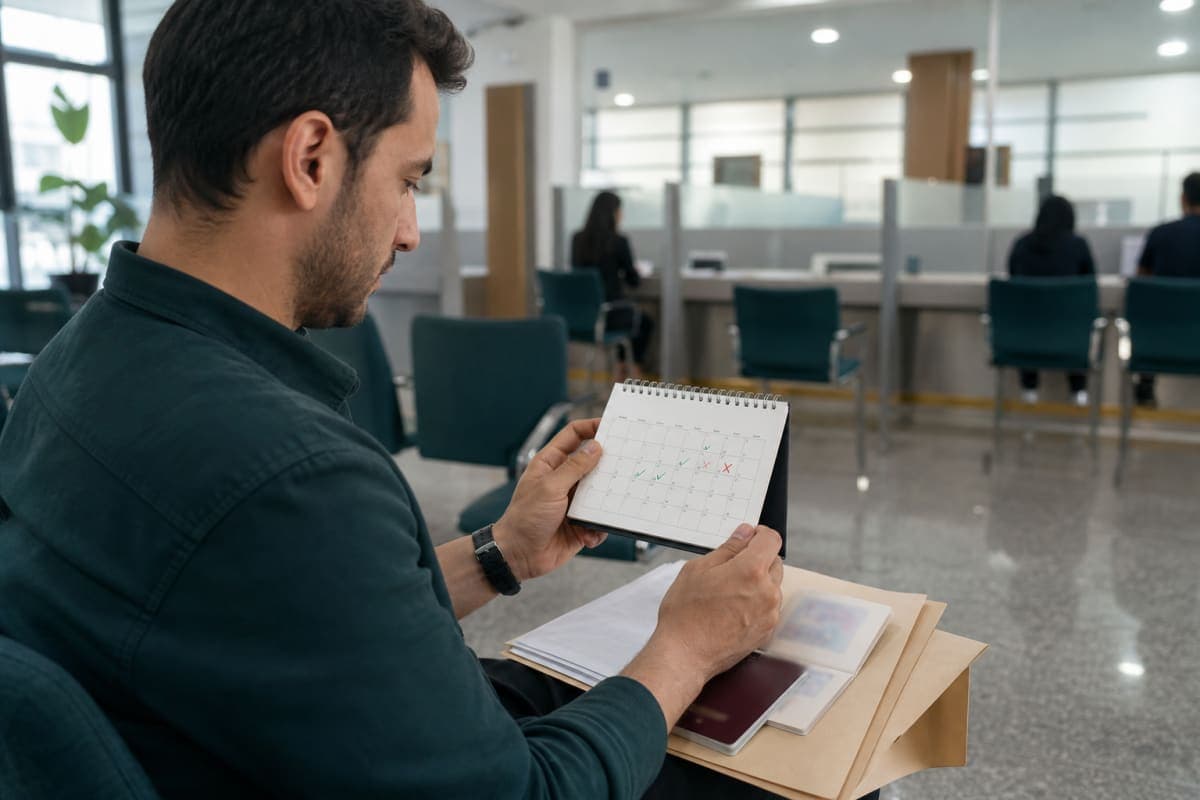
To maintain legal status in Turkey, count every day you spend in the country within a rolling 180-day period and do not exceed the permitted 90 days if the 90/180 rule applies to your country. If you plan to stay longer, apply for ikamet before your lawful period of stay ends, not after it has expired.
The 90/180 rule seems simple until a person has several entries, short exits, transit trips, and plans to apply for a residence permit. A mistake of just one or two days can lead to overstaying, a fine upon exit, problems with a new application, or the risk of an entry restriction. Below is a practical algorithm that helps a foreigner check their dates before applying for ikamet, understand their remaining day allowance, and move from short-term stay status to resident status on time.
Step 1: Check Your Entry Regime for Turkey
First, determine the legal basis on which you are staying in Turkey: visa-free entry, an electronic visa, a regular visa, or an already valid residence permit. The rule of 90 days within 180 days applies to many foreigners, but the specific conditions depend on citizenship and type of entry. You should check not based on advice in chat groups, but against official Turkish information and the conditions that were in force specifically on the date of your entry.
In practical terms, this means: open the visa information page of the Turkish Ministry of Foreign Affairs or the e-Visa system, find your country, and record the permitted period of stay. There is no cost for this check if you do it yourself, but choosing the wrong regime can be costly at the border or when applying for ikamet. If you have an old visa, a new passport, or a change of citizenship, check the conditions separately for each document.
- Documents to check: international passport, visa sticker or e-Visa, entry and exit stamps, old passports with Turkish stamps.
- What to check: permitted number of days, number of entries allowed, visa start date, visa expiry date or end date of the visa-free period.
- When to check: before buying a ticket, immediately after entry, and always before applying for ikamet.
Step 2: Collect All Entry and Exit Dates
To calculate 90/180, you need not only your current dates but also all entries to and exits from Turkey over the past months. The day of entry is usually counted as a day of stay, and the day of exit is also counted as a day of stay. Therefore, a short trip over two calendar days may use two days of your limit, even if you arrived in the evening and departed in the morning.
Collect data from your passport, boarding passes, flight tickets, airline SMS messages, and personal calendar. If a passport stamp is hard to read, it is better to verify the date using the ticket or request the travel history from the carrier. The time required for this check depends on the number of trips, but it should not be postponed: once the limit is close to ending, there is almost no time left to correct anything.
- Record: the date of each entry into Turkey, the date of each exit from Turkey, the country of departure, and the passport number.
- Check: whether there were entries using an old passport, a second citizenship, or a land border.
- Keep: copies of passport pages with stamps and PDF tickets: they may be useful during a consultation or in a disputed situation.
Step 3: Count Days Using a Rolling 180-Day Period
The key feature of the 90/180 rule is that the period is not a fixed calendar half-year. It is a rolling window: for any selected date, you need to look back 180 days and count how many days you actually spent in Turkey. If the total reaches 90 days, further stay without ikamet may become a violation, even if a new month or a new year has started.
A convenient method is to create a table with columns for entry, exit, number of days, control date, and total for the last 180 days. This calculation costs nothing if you maintain the table yourself, but if your travel history is complex, it is better to ask a specialist to check the logic. It is important not to count only the most recent trip: older days inside the 180-day window continue to affect your limit.
- Formula: choose a check date, count back 180 calendar days, and add up all days spent in Turkey within that window.
- If the result is 90 days: staying longer without a residence permit is risky unless you have another lawful basis.
- If the result is less than 90 days: the remaining days are your practical reserve, but it changes every day.
Step 4: Assess the Risk of Overstaying Before Applying for ikamet
Overstaying means staying in Turkey after the permitted period under a visa, visa-free regime, or another legal basis has ended. The risk arises not only after an obvious 90-day overrun, but also when a person mistakenly believes that a short exit resets the limit. Leaving Turkey does not automatically reset the 90/180 rule: what matters is the calculation of days in any 180-day period.
If you see that your limit is almost exhausted, do not plan travel and an ikamet application for the last day. In practice, technical issues with e-İkamet may arise, as well as problems with the address, insurance, photos, or rental documents. The amount of an overstay fine depends on citizenship, the period of violation, and the assessment of the competent authorities, so it is not correct to name one universal amount in advance.
- Red flags: less than a few days of reserve remain, there have been frequent entries and exits, there is no confirmed address, there is no health insurance for a residence permit.
- What to do: recalculate the days, check the requirements for your ikamet category, and prepare the documents before your lawful period ends.
- Useful reading: overstay risks when renewing a residence permit in Turkey, if you have already had ikamet.
Step 5: Apply for ikamet Before the Permitted Stay Ends
If you want to remain in Turkey longer than the 90/180 rule allows, you need to switch to a legal basis — ikamet, meaning a residence permit. The application is submitted through the e-İkamet system, and the type of residence permit depends on your situation: tourism, study, family, work, digital nomad status, or another basis. You should apply before your lawful period of stay expires, because applying after a violation may create additional risks.
After the online application, the system generates a registration form and sets the further procedure for submitting documents, including a randevu or submission according to instructions, if this applies to your situation. Government fees and card costs depend on citizenship, the duration of the residence permit, and the category, so they must be checked in e-İkamet and through current payment channels. See the detailed procedure in our article how to obtain a tourist residence permit in Turkey through e-İkamet.
- When to apply: before the visa or visa-free period ends, allowing time to collect documents.
- What matters: correct address, valid passport, health insurance, photographs, and proof of the basis for the residence permit.
- After applying: monitor notifications, SMS messages, and the application status; instructions are available here: how to check the status of a residence permit application in Turkey.
Documents for Status Control and Application
For the 90/180 calculation and preparation for ikamet, it is better to create a separate folder containing both migration dates and residence permit documents. This helps you quickly explain your situation to a consultant, an authority officer, or, if necessary, at the border. Do not rely only on memory: with several trips, people often make mistakes in dates.
The list of documents depends on the residence permit category, citizenship, and requirements at the time of application. Below is a basic practical list for an initial check, not a universal guarantee of approval. Before applying, you must verify the requirements in e-İkamet and prepare documents specifically for your category.
- International passport and copies of pages with personal data, the latest entry, and visas.
- Old passport, if it was used for trips to Turkey within the last 180 days.
- List of all entries and exits with dates and supporting evidence.
- Electronic visa or visa sticker, if applicable.
- Biometric photographs for ikamet in line with current requirements.
- Health insurance suitable for the selected type of residence permit.
- Documents for the residential address: rental agreement, the owner’s tapu, or other confirmation depending on the situation.
- Completed e-İkamet form and confirmations of payment of official fees, if calculated by the system.
What to Pay Attention To
Do not use the rule as permission to live in Turkey through constant short cycles without analyzing your status. Even if you mathematically have days remaining, border and migration practice assesses the legality of stay based on documents, the purpose of entry, and current rules. Those who work online, seek long-term rentals, or plan to open a company should be especially careful.
A separate risk is attempting to apply for ikamet when the limit has already been exhausted. In such a situation, you should not guess; you need to assess the actual dates, the possible consequences of departure, and the chances of a correct application. If you receive a refusal, do not resubmit mechanically: study the reasons and the procedure, including the article what to do after a residence permit refusal in Turkey.
- Do not reset the limit by exiting: the 90/180 rule remains rolling.
- Do not apply on the last day: a technical error can turn into a status violation.
- Do not confuse a visa with a residence permit: a visa gives the right to short-term entry, while ikamet allows residence within the approved period.
- Do not ignore the purpose of stay: for remote work and long-term residence, study the legal status of a digital nomad in Turkey.
Conclusion and ESG Consulting’s Comment
The main conclusion is simple: the 90/180 rule must be calculated not from the last entry and not by calendar half-years, but within each rolling 180-day window. This calculation helps you see in advance how many days remain, when it is safer to prepare documents, and at what point you need to proceed with an ikamet application.
ESG Consulting regularly sees the same problem: foreigners count 90 days from the last entry, not within each 180-day window. As a result, a person may be certain that everything is legal, although in fact the limit has already been exhausted. Correct calculation before applying for ikamet is not a formality, but the foundation of the entire migration strategy.
We recommend checking your days immediately after entry, then one month before the expected end of the limit, and again before submitting the application. ESG Consulting is a Turkish migration and legal consulting company with over 6 years of experience; we support clients in Russian, Turkish, and English on matters of ikamet, work permits, citizenship, real estate, and corporate solutions. Our task is not to promise the impossible, but to show risks in advance and choose a lawful path.
Frequently Asked Questions
Does the 90/180 rule mean 90 days in each calendar half-year?
No, it is not a calendar half-year, but a rolling 180-day period. For any date, you need to look back 180 days and count the actual days of stay in Turkey within that window.
Are the day of entry and the day of exit counted toward the limit?
Yes, in practice both calendar days are counted as days of stay. Therefore, even a short trip with an evening arrival and a morning departure may use two days of the limit.
Does a short exit from Turkey reset the 90 days?
No, a short exit does not by itself reset the limit. Older days gradually drop out of the calculation only when they fall outside the last 180 days.
Can I apply for ikamet on the last day of my permitted stay?
Technically, it is important to apply before the lawful period expires, but postponing until the last day is risky. A system failure, incomplete documents, or an error in dates may lead to overstaying.
What should I do if I have already exceeded 90 days?
First, you need to calculate the dates accurately and assess your status, then choose a safe course of action: departure, consultation, or checking the possibility of application. The amount of the fine and the consequences depend on the specific situation, citizenship, and period of violation.
Do I need a residence permit if I work online from Turkey?
If you plan to live in Turkey longer than the permitted visa or visa-free period, you need legal status, usually ikamet. For remote work, it is important to separately assess the purpose of stay, tax issues, and migration risks.
Official Sources
 Related ServiceResidence Permit in TurkiyePlanning to move to Turkiye and live here legally? ESG Consulting will help you obtain a residence permit quickly, smoothly, and in full compliance with Turkish legislation. Our experienced team provides complete assistance throughout the entire process, from document preparation to receiving your residence permit.Explore Service
Guide steps on this topic
Residence Permit Guides
View all- First Application
- Appointment and e-Residence
- Address Registration
- Extension Application
- Rejection and Appeal
- 90/180 Stay-Day CalculationThis article
- Long-Term Residence


