School in Turkey for Foreigners: Enrolling a Child Without Mistakes
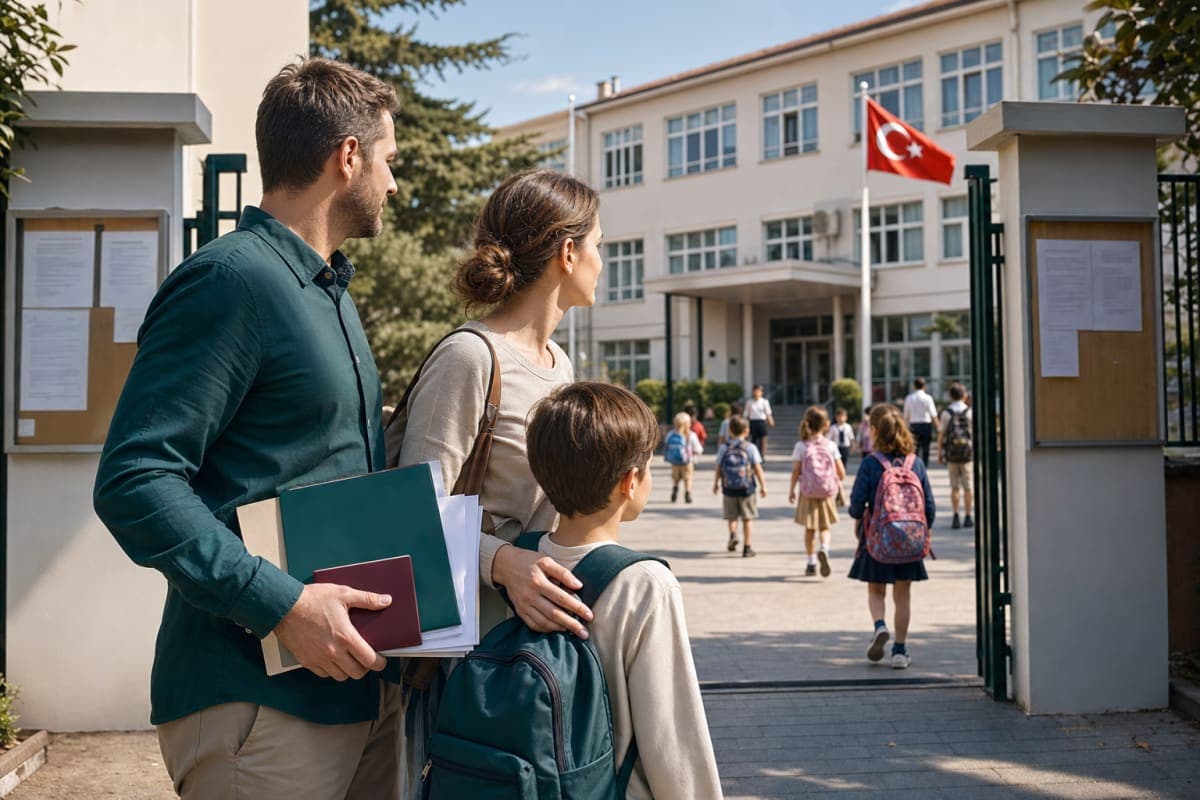
To enroll a foreign child in a school or kindergarten in Turkey, the family needs to determine the type of institution, confirm their residential address, prepare the child’s documents, and contact the school, kindergarten, or district education directorate. For public schools, address registration is usually key, while for private schools the main factors are the contract with the institution and its internal admission rules.
Children of foreigners in Turkey may study in both public and private schools. In practice, the enrollment procedure depends on the family’s status, whether the child has a foreign national ID number, the child’s age, the district of residence, and available places at the specific institution. It is therefore better to start preparing in advance: check the documents, understand the requirements of the chosen school, and clarify which steps apply in your particular district.
Step 1: Determine the Child’s Age and Education Level
First, it is important to understand which level the child falls into under the Turkish system. Compulsory school education in Turkey lasts 12 years and is usually divided into primary school, middle school, and high school. Kindergarten and preschool groups are a separate stage and may operate within public institutions, municipalities, or private kindergartens.
For a relocating family, this is not a formality: the child’s age affects the list of documents, language of instruction, requirements for previous education, and the possibility of assignment by address. If the child has already studied abroad, the school may request a report card, a certificate of enrollment, or translated documents in order to determine the appropriate grade. In disputed cases, the issue is usually resolved through the school administration or the district directorate of national education.
Step 2: Choose a Public or Private School
Public schools in Turkey usually admit children based on the family’s residential address. Instruction in these schools is in Turkish, and enrollment is most often tied to the district and neighborhood. For foreigners, this means that without a correct address in the system, difficulties may arise when assigning the child to a school.
Private schools and international programs follow their own admission rules. They may conduct an interview, language testing, request academic documents, and offer different curricula. Tuition fees, entrance payments, meals, transportation, and uniforms depend on the specific school, so it is safer to request an official contract and written price list before making any payment.
Before choosing, it is worth comparing not only the price or reviews, but also the daily logistics: the commute to school, schedule, language of communication with parents, and whether there is support for the child during the adjustment period. Even a good school may turn out to be inconvenient if the journey takes too long or the contract terms remain unclear.
Step 3: Check the Residence Permit, Kimlik, and Family Address
To enroll a child, a foreign national ID number is often required; for residence permit holders, it starts with 99. If the family has only just submitted the ikamet application, the school may request confirmation of the application, but the final decision depends on the institution and the district education directorate. For status-related questions, it is useful to understand in advance how checking the status of a residence permit application in Turkey works.
The address is especially important for public schools because placement is usually linked to the registered place of residence. After receiving a residence permit, foreigners need to update their address in the official system; we covered this in more detail in our article on address registration in Turkey after receiving a residence permit. If the address in the rental agreement, in the system, and in the school documents does not match, enrollment may be delayed.
At this stage, parents should check not only the child’s documents but also the overall status of the family. If the residence permit is still in process, the address has not yet been registered, or the data differs across documents, it is better to find this out before visiting the school, not during the application submission.
Step 4: Prepare the Child’s and Parents’ Documents
Before visiting the school, it is best to prepare a document package in two versions: originals and copies. Turkish institutions may approach translations and certification of foreign documents differently, so clarify the requirements in advance with the specific school or ilçe milli eğitim müdürlüğü — the district education directorate. If a document was issued outside Turkey, a Turkish translation and notarization may be required.
For a private school, the list is usually broader because the institution signs a contract with the parents and checks the child’s academic history. For kindergarten, they may additionally request medical information, vaccination records, contact phone numbers, and permissions for pick-up or accompaniment. You should not hand over the only originals without a receipt or necessity: in most cases, it is enough to show the original and leave a copy.
If the child does not have a residence permit or the family is in the process of obtaining one, it is better to get a written explanation from the school or district directorate in advance. For children moving together with their parents, it is also important to check the legal basis for the entire family’s stay; in some cases, a family residence permit in Turkey for spouses and children is suitable, while in others a separate application strategy is needed.
List of Documents for School and Kindergarten
The exact list depends on the region, school, and family status, but the basic set is usually similar. Below is a practical checklist that is convenient to take to an initial consultation. Before submitting an application, always verify the requirements with the specific institution so you do not waste time on repeat visits.
- Child’s passport and a copy of the data page.
- Kimlik / foreign ID number, if the residence permit has already been issued.
- Parents’ documents: passports, kimlik, contact details.
- Proof of address: address registration, rental agreement, or another document requested by the school.
- Birth certificate, with translation and certification if required.
- Education documents: report card, certificate from the previous school, transcript of grades.
- Child’s photographs, if requested by the institution.
- Medical information and vaccination records, especially for kindergarten.
- Contract with a private school or kindergarten, if a paid option has been chosen.
Step 5: Submit the Application to the School, Kindergarten, or Education Directorate
If you have chosen a public school, start with the institution assigned to your residential address. The administration will check the child’s data, address, and availability of places, and then advise you on the next step. If the school cannot accept the child or the data does not appear in the system, parents may be referred to the district directorate of national education.
For a private school, the process is usually structured differently: an application, a meeting with the administration, review of the program, financial terms, and signing of the contract. Carefully check what is included in the cost: tuition, meals, school bus service, textbooks, uniform, extracurricular clubs, and deposit may be charged separately. Any promises regarding a discount, refund, or transfer to another campus are best recorded in writing.
Do not rush to sign documents on the day of the first visit if the terms are unclear. Clarify who the contracting party is, how payments are processed, which services are included in the base price, and what happens in the event of termination. For a family that has just moved, these details may be no less important than the ability to enroll the child itself.
Step 6: Organize the Child’s Adaptation to the Turkish Environment
Even if the documents are accepted without problems, the child will need time for language and social adaptation. In public schools, the main language is Turkish, so basic lessons, speaking practice, and familiarity with school vocabulary are useful in advance. For younger children, grammar is often less important than the ability to ask for help, understand the teacher, and communicate with classmates.
Parents should maintain regular contact with the class teacher or administration. Clarify which channels the school uses to communicate schedules, homework, parent meetings, and events. In private schools, this may be a mobile app or electronic system, while in public schools it may be announcements, messengers, and direct communication with the teacher.
In the first weeks, it is useful to monitor not only grades, but also the child’s mood, sleep, willingness to go to school, interaction with peers, and understanding of basic rules. If the child is shy about speaking Turkish, it is important to explain in advance whom they can ask for help and how to tell the teacher or parents about a problem.
What to Pay Attention to Before Enrollment
The main risk for a family is choosing a school based only on reviews in chats, without checking the address, language of instruction, and actual contract terms. In Turkey, even schools in neighboring districts can differ greatly in schedule, workload, student composition, and communication with parents. It is better to visit the institution in person, check the route, ask the administration questions, and clarify who will support the child during the first weeks.
Separately check payment and refund matters at private institutions. Do not sign a contract if it is unclear when and for what the school may retain payment, how termination is formalized, and what happens if you move to another city. If the family still needs to apply for or renew ikamet, assess immigration risks in advance; the basic process is described in our guide to the tourist residence permit in Turkey via e-İkamet.
- Address linkage: for a public school, the district of residence may be decisive.
- Language of instruction: clarify whether there is support for children who do not speak Turkish.
- Available places: availability is best confirmed directly with the school.
- Contract: all payments and refund terms should be clear before signing.
- Transportation: check the route, travel time, and school service rules.
- Adaptation: ask who helps foreign children during the first weeks.
Comment from ESG Consulting
In our practice, families most often face not a refusal as such, but inconsistencies in documents: the address is not registered, the residence permit is in process, a translation is missing, or the previous school has not issued a clear certificate. Therefore, preparation for school should start not with looking for uniforms and textbooks, but with checking the family’s legal status and address. This is especially important for those who have recently moved and have not yet established communication with local institutions.
ESG Consulting assists foreigners in Turkey with ikamet, family residence permits, address registration, documents for children, and communication with institutions. We work in Russian, Turkish, and English and help families choose a realistic course of action without unnecessary promises. If the situation is non-standard — a child without a complete set of documents, a move to another city, a school refusal, different surnames for parents and child — it is better to review it before submitting the application.
The main conclusion: successful enrollment of a child in a school or kindergarten in Turkey starts with consistent documents, a clear address, and a realistic assessment of the institution’s requirements. The earlier the family checks its status, prepares translations, and clarifies admission rules, the lower the risk of delays and repeat visits.
Frequently Asked Questions
Can a foreign child study in a public school in Turkey?
Yes, children of foreigners can study in public schools in Turkey if the document and address requirements are met. In practice, the school checks the child’s age, status, residential address, and availability of places.
Is a residence permit required to enroll a child in school?
A residence permit or foreign ID number usually makes enrolling a child much easier. If the residence permit application is still under review, the possibility of a temporary solution should be clarified with the school or district education directorate.
Can a child be enrolled in a school outside the residential address?
For public schools, the residential address usually matters, so enrollment outside the address may be impossible or require approval. Private schools are more often not tied to an address, but they admit students according to their own internal rules.
Do school documents need to be translated into Turkish?
Yes, a translation may be required, especially if the child has already studied abroad and the grade level needs to be determined. Notarization requirements should be clarified in advance with the specific school or education directorate.
How much does school or kindergarten cost in Turkey?
Public school education usually does not involve tuition fees, but there may be expenses for meals, uniforms, transportation, and materials. Private schools and kindergartens set their own prices, so you should request an official price list and contract.
How can I help my child adapt to a Turkish school?
It is better to start basic Turkish in advance and maintain contact with the teacher after enrollment. In the first weeks, it is important to monitor not only grades, but also the child’s emotional state, communication with classmates, and understanding of school rules.
Official Sources
Guide steps on this topic
Turkey Guide Guides
View all- First 30 Days
- Phone and Internet
- Transport
- Schools and KidsThis article
- Cost of Living
- City Guides
- Leaving Turkey